Scott Wills Contracting
Utility Tree Services
Call For a Free Quote
Get In Touch With Us!

Residential and Commercial
Our team of professional arborists and groundsmen can take care of whatever residential and commercial tree removal project you have in mind.

Utility
With our well-trained and certified arborists and specialized equipment, our team will ensure the safety and reliability of your utility services.
Are you looking for utility tree services experts in Cranbrook or the East and West Kootenays?
Scott Wills Contracting is a reliable and experienced company that provides high-quality utility tree services in Cranbrook and the East and West Kootenays. Our team of certified utility arborists are equipped with the tools and techniques to provide efficient and effective tree services to our utility clients.
We specialize in using bucket trucks or climbing techniques to access hard-to-reach areas, allowing us to perform pruning, removal, and other tree services safely and efficiently. Our team is also trained in hazard tree removal, which is a crucial part of utility tree services to minimize the risk of power outages and safety hazards.
At Scott Wills Contracting, we understand the importance of providing reliable and efficient tree services to our clients. That’s why we use advanced techniques and equipment to complete projects in a timely and cost-effective manner, without compromising on safety or quality.
Whether you require pruning, removal, or other tree services, our team at Scott Wills Contracting is here to help. Contact us today to learn more about our utility tree services and how we can assist you with your tree service needs in Cranbrook and the East and West Kootenays.
Hazard Tree Removal
Hazard tree removal is an important part of utility tree services, especially in areas where trees pose a threat to power lines or public safety. Hazard trees are trees that are damaged, diseased, or have structural defects that make them more likely to fall or drop limbs, posing a risk to people or property.
We prioritize hazard tree removal to minimize the risk of power outages, electrical fires, and safety hazards. Identifying and removing hazard trees can be challenging and requires trained professionals who can assess the trees’ condition and determine the appropriate action.
Hazard tree removal typically involves cutting down the tree and removing it from the site. In some cases, the tree may need to be dismantled in sections to avoid damage to nearby structures or power lines. The wood debris generated during the removal process is then chipped or disposed of properly.
Overgrown Trees
Diseased Trees
Storm Damaged Trees
Pest Ridden Trees
Leaning Trees
Wood Chipping
Wood chipping is another important aspect of utility tree services. When trees are pruned or removed, the branches, limbs, and trunks need to be disposed of properly. Wood chipping is an efficient and environmentally friendly way to dispose of this wood debris.
We use wood chippers for several reasons. Firstly, it allows for the safe and efficient disposal of wood debris generated during tree work. Without chipping, the wood debris would need to be transported to a landfill or another disposal site, which can be costly and time-consuming.
Secondly, wood chipping is an environmentally friendly way to dispose of the wood debris.
Finally, using wood chippers for utility tree services is an effective way to manage the environmental impact of tree work. Chipping the wood debris on-site reduces the amount of material that needs to be transported, minimizing the impact on local roads and traffic.
Eco-Friendly
Minimize Impact
Cost and Time Savings
Easy Disposal
Right of Way Clearing
We use a variety of techniques to manage vegetation along rights-of-way. Pruning is a common practice, which involves trimming back the branches of trees to prevent them from growing into the power lines. This can be done using hand tools or power equipment, depending on the size and location of the vegetation.
In some cases, it may be necessary to remove entire trees or shrubs that are growing too close to the power lines. This can be a more complex process, as it may require the use of heavy equipment to safely cut down the vegetation without damaging the power lines or nearby structures.
Ensure Safety
Minimize Risk
Prevent Outages
Allow For Ease Of Maintenance
Utility Bucket Truck Tree Services
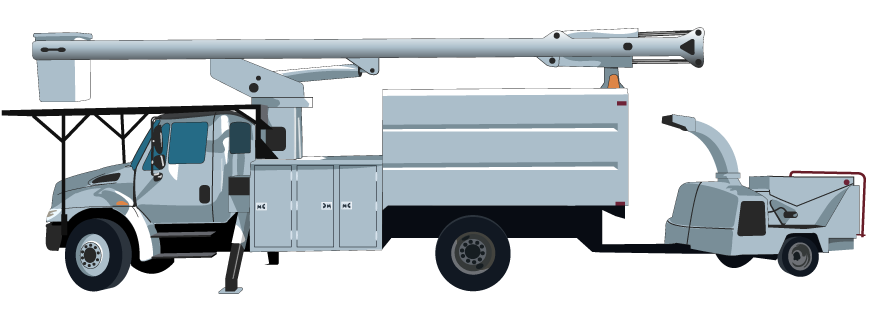
Bucket trucks, also known as aerial lift trucks, are an essential tool for utility tree services. These trucks are equipped with a hydraulic arm that extends upwards, allowing workers to access hard-to-reach areas, such as the tops of trees or power lines.
Using bucket trucks for utility tree services has several advantages. Firstly, it allows for more efficient and effective tree trimming and removal, as workers can access all parts of the tree easily. Secondly, it improves safety for both workers and the public by minimizing the risk of accidents related to tree work or power lines. Finally, it reduces the amount of time and effort required for tree work, as workers can complete tasks more quickly and with greater accuracy.
Cost Effective
Reduced Time and Effort
Quick & Safe
Reach Hard To Reach Areas
Frequently Asked Questions About Utility Tree Services
If you’re considering hiring a utility tree services company, you may have some questions about the process and what to expect. Utility tree services are important for maintaining the safety and reliability of power lines and electrical infrastructure, and it’s essential to hire a reputable and experienced company to get the job done right. In this article, we’ll answer some frequently asked questions about utility tree services, so you can make an informed decision when it comes to your tree care needs.
What does a utility arborist do?
A utility arborist is a professional who specializes in providing tree care services for utility companies, such as power companies and municipalities. The primary responsibility of a utility arborist is to maintain the safety and reliability of the utility’s power infrastructure by managing vegetation around power lines and other utility equipment.
Utility arborists use their expertise to determine which trees may pose a risk to power lines and other infrastructure, and they develop strategies to manage those trees. They may prune, remove, or relocate trees to ensure that they do not interfere with power lines or other equipment.
In addition to managing vegetation, utility arborists may also be responsible for inspecting trees for signs of disease or damage that may require removal. They may also be involved in planting and maintaining trees in areas where vegetation has been cleared.
Utility arborists work closely with other professionals, such as utility line workers and engineers, to ensure that the vegetation management plan aligns with the utility’s infrastructure needs. They also prioritize safety and adhere to strict safety guidelines to prevent accidents and injuries.
Overall, the role of a utility arborist is crucial in maintaining the reliability of the utility’s power infrastructure and ensuring the safety of the public and utility workers.
What is a certified utility Arborist in British Columbia?
In British Columbia, a certified utility arborist is a professional who has completed specialized training and certification to work in the utility arboriculture industry. This type of arborist is specifically trained to work with trees in close proximity to power lines and other utility infrastructure, ensuring safe and reliable electricity supply to British Columbians.
To become a certified utility arborist in British Columbia, an individual must complete training through the British Columbia Hydro Power Line Technician and BC Hydro Power Line Maintainer programs. These training programs provide comprehensive instruction on best practices for vegetation management around utility infrastructure, including power lines and transformers.
Upon completing the training programs, the individual must pass a certification exam to become a certified utility arborist. The certification exam is designed to test the individual’s knowledge of the skills and techniques required to work safely and effectively in the utility arboriculture industry.
Certified utility arborists in British Columbia must adhere to strict safety guidelines and regulations, as well as industry best practices, to ensure that they are working safely and efficiently. They are responsible for managing vegetation around power lines and other infrastructure to reduce the risk of power outages, fires, and other hazards.
Overall, certified utility arborists in British Columbia play an important role in maintaining the reliability of the province’s electrical infrastructure, ensuring safe and reliable electricity supply to homes and businesses.
Who is responsible for trimming trees around power lines?
In most cases, the responsibility for trimming trees around power lines falls on the utility company that owns and operates the power lines. Utility companies have a legal responsibility to maintain safe and reliable electrical service for their customers, and tree trimming is an important part of this responsibility.
Utility companies typically hire team of trained and certified utility arborists who are responsible for managing vegetation around power lines. These professionals use specialized equipment, such as bucket trucks and pruning saws, to safely and effectively trim trees and remove branches that could interfere with power lines.
In some cases, property owners may also have a responsibility to ensure that trees on their property do not grow too close to power lines. If a tree on private property is growing too close to a power line, the property owner may be responsible for trimming the tree or hiring a professional to do so.
It’s important to note that trimming trees around power lines can be dangerous work, and should only be done by trained professionals with the necessary equipment and expertise. Attempting to trim trees around power lines on your own can be extremely dangerous and should be avoided. If you have concerns about trees growing too close to power lines, contact your local utility company to report the issue and request assistance.
.